Myself and Rob have been in discussion over email about suitable warm up and cool down exercises for the workshop. The email chain is too large to include within this blog so I will sum it up.
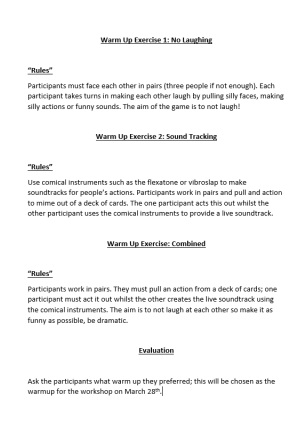
Rob gave me feedback on the warm ups I had suggested. He thought that we should try and keep them focused on music since the workshop is music based. He suggested that people should do the ‘no smiling’ exercise in pairs rather than in a large group. He believes this will force people to focus on each other more. He also suggested using comical instruments such as the vibraphone and have participants create a live soundtrack to other people’s actions. This means having one person act out something and another person providing the music to match that. I then believed that we could link these exercises and have them try not to laugh whilst doing the sound tracking exercise. Rob believed it might become too complicated so in order to discover this I am going to trial the two exercises individually and combined at the Baton Beats sessions I work at on a Monday. Below are my plans for these exercises. These will be tested at the session on 24/02/2020 and I hope to find out from the group which warm up was preferred and use this as my warm up for the workshop on March 27th.
Also within my emails with Rob, we decided on a definite cool down exercise. The aim is to silently pass an instrument which makes noise with movement, such as an ocean drum. This will hopefully help people focus, calm down and allow for personal reflection on the session.
I have also been considering how I wish to evaluate the Creative School pupils. As I mentioned previously, I wish to critically reflect on my work within the project and feel gathering feedback from the Creative School pupils is my easiest method of doing this. Originally, I wanted to ask them to fill out questionnaires however I would have to gain permission from the school as I am collecting individual data. Instead, I have a preferred option in which I would only need to fill out a university ethics form. The idea is as follows; I would section the room into three and each section would represent a different answer. I would then ask the pupils a question and they would stand in the area that represents their answer. I could then record which area had the most pupils stood in and use this to reflect upon.
There have been developments in the engagement with the Seven Keys of Collaboration (Spencer, 2017). Through our shared email contact, we have developed candour which has improved our structure that relates to our shared vision. We are both having fun whilst developing this project and have proved to one another that we are dependable and trustworthy collaborative partners. This has improved our working relationship and enhanced my collaborative skills including time management to carry out individual tasks and inspiration. Furthermore, this is the first time I have experienced candour in a collaborative setting, this forced me to adapt how I responded to criticism and other ideas.
On Monday I will be having my second meeting with Rob in which we will discuss whether this is a suitable option and how is best to ask the questions. Once I have confirmed this with Rob, I will fill out an ethics form and my method of evaluation will be decided. I will also conduct contextual research into evaluation methodology.
Reference List
Spencer, J. (2017). The 7 Keys to Creative Collaboration. YouTube. Available at: https://www.youtube.com/watch?v=2DmFFS0dqQc [Accessed 8 Feb. 2020].
 Emily Pembridge MUS634