On 09/03/2020 I had my third meeting with Rob in which we were going to discuss everything we have decided so far and finalise any other collaborations that we needed to make. I was also going to trial the main activity that evening within the Baton Beats session. However, the whole project became compromised due to the Coronavirus outbreak. Rob said that it was highly likely that the workshop would not take place due to the government’s potential implementation of social distancing, particularly for vulnerable people. Therefore we had a huge problem to overcome. I had two options, the first to ignore Rob’s warning, continue planning the workshop for the 27th March and A) It either go ahead or B) The workshop is cancelled and I have no realisation for my project. My second option that Rob suggested was that we ran the workshop that evening, during the Baton Beats session. The workshop we had planned for March 27th was tailored for the participants from the Highbury Trust and the Creative School. This was the plan for the 27th;
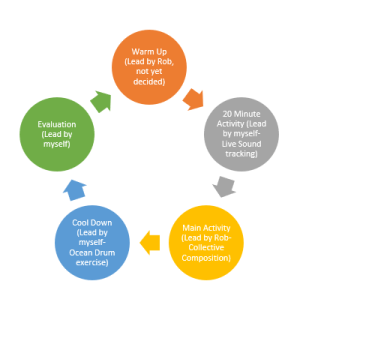
The workshop was going to be lead by myself and Rob within different sections however all of the ideas within the workshop were collaboratively developed as evidenced in my previous blogs. By doing the workshop that evening, it meant that we would not be able to use the main activity as this was specifically developed to meet the aims of the Highbury Trust and the Creative School. This also meant that I would have to tailor my evaluation around the change. Myself and Rob decided that if we ran an altered version of the workshop that evening then I would have a realisation for my project, even if it is not the exact original that was planned. Furthermore, if the workshop goes ahead on the 27th March, then it would have been a good trial run. Upon deciding this, we then had an hour to problem solve and collaborate on an altered version of our original plan.
My first concern was audio recording consent, consent for the evaluation, safeguarding and risk assessing. Luckily, because Baton Beats is a weekly workshop at PMZ, all participants sign consent forms when they join the group. Furthermore, PMZ have safeguarding and risk assessments already in place which meant that I no longer had to worry about these aspects and we could begin arranging the session.
We decided that as Baton Beats are already working towards their own goals, we would incorporate this into the session. We decided that the structure would be as follows;
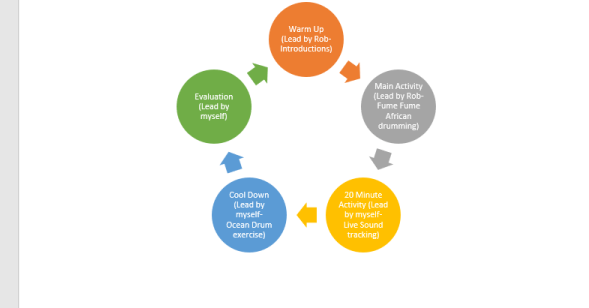
The warm up was the usual warm up we tend to use during the Baton Beats session. The main activity was Fume Fume which is an African Drumming song that the group have been learning for roughly three weeks. As I work at PMZ, I collaborate with Rob on this exercise every week to deliver it to the group so despite us not having planned this from the beginning, it is still a long term collaborative project within its own right. Within this exercise, we decided to teach the group the lead drumming parts. The 20 minute activity was exactly as planned for March 27th, as was the cool down. The evaluation was also similar however I only asked the three questions that were generic rather than the ones tailored to the original planned session. We audio recorded the 20 minute activity, the cool down and the evaluation as these were within the original plan. In order to remain in line with GDPR, the file is only available to myself and the assessor who I will give the link to once the assignment is finished. The audio recording will then be destroyed.
We then set about setting up the room for the session using the kit lists that were planned for the 20 minute activity and the cool down. We then had to also arrange the equipment for the altered sections of the workshop.
Overall, despite conducting the workshop two weeks early, altering it to fit a new group and working under pressure, myself and Rob’s collaboration and problem solving really paid off. As you can hear in the recording, the group had fun throughout the 20 minute exercise and the cool down and I received really helpful feedback from the group members during the evaluation. Furthermore, the session as a whole including the altered parts fitted in well with the rest of the workshop and felt natural.
This event had an effect on how we engaged with every single collaborative key (Spencer, 2017). In 45 minutes we had to depend on each other and trust each other that we would be able to support one another within the new structure. We had to ensure we were still working towards the shared vision and having fun meanwhile problem solving. We had to be coherent and kind when using candour in order to remain feeling empowered. This event taught me a lot of key collaborative skills including patience, problem solving, trust and inspiration and I feel that the continual growth that my collaborative self had been on throughout this project paid had off during this moment.
Myself and Rob are now going to continue planning the session for March 27th until we receive confirmation that it will not be going ahead. We will use the feedback from March 9th to improve the workshop itself. If the session is cancelled on March 27th then the audio recording of March 9th will be the realisation of this project and a blog will be uploaded explaining the situation. As is understandable, it is a stressful situation to be in however I feel we overcame the issue calmly, professionally and worked together to form the best outcome that we could.
Reference List
Spencer, J. (2017). The 7 Keys to Creative Collaboration. YouTube. Available at: https://www.youtube.com/watch?v=2DmFFS0dqQc [Accessed 8 Feb. 2020].
 Emily Pembridge MUS634