Another contextual area that relates to the collaboration is Music Therapy, Community Music and Teaching. I wanted to research these during the development of my project as it is important to understand how they relate to my collaboration and if there are any methods I could have carried over. Despite the realisation already taking place, I still wish to place my collaborative project within these areas to see how it fits and gain ideas of how I could use this to influence future projects.
According to the British Association of Music Therapy (Bamt.org, 2019), “Music therapy is an established psychological clinical intervention, which is delivered by HCPC registered music therapists to help people whose lives have been affected by injury, illness or disability through supporting their psychological, emotional, cognitive, physical, communicative and social needs”. Please see a video below of music therapy in practice.
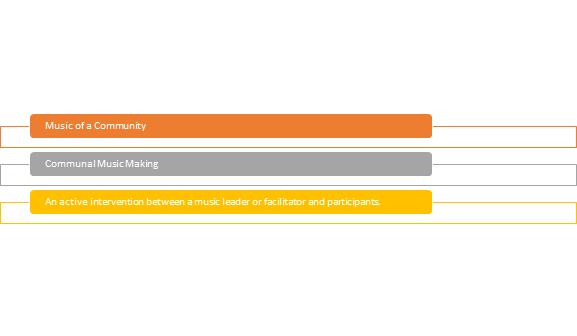
In comparison, Higgins (2012, p.3)states that community music can be three things;
Please see the video below of community music in action at PMZ.
My project links to this contextual area as it would be classed as Community Music. It brought the community together within the Baton Beats session to create music, therefore inducing communal music making. It embraced music from the African Culture that showcased music of a community and was an active intervention between a music leader and the participants. All participants who come to PMZ are in some way vulnerable, whether that be due to disabilities, learning difficulties, old age or loneliness. Therefore, the music created within the workshop can be seen to be therapeutic. At the end of the workshop, I asked if the group felt that their mood was boosted by the session in which the majority agreed. So despite the workshop not being formal music therapy, the community music created was certainly therapeutic.
As a soon to be trainee music therapist, this workshop gave me valuable experience in working with vulnerable people in a musical environment. It gave me insight into how people react to things differently and that I should be mindful of each person’s individual needs. Furthermore, from seeing how the music impacted the participants in a positive way, this also made me feel positive. This has proven to me that the career path I wish to follow is certainly for me.
Another contextual practice that links to my collaboration is inclusive teaching methodologies. Despite the workshop I conducted not being a teaching workshop, the principles can be transferred. The University of Southern California (2019) have a page on their website dedicated to this topic. They believe that there are four contemporary music teaching strategies that can be employed to create an inclusive and engaging classroom/work-space. These are as follows;
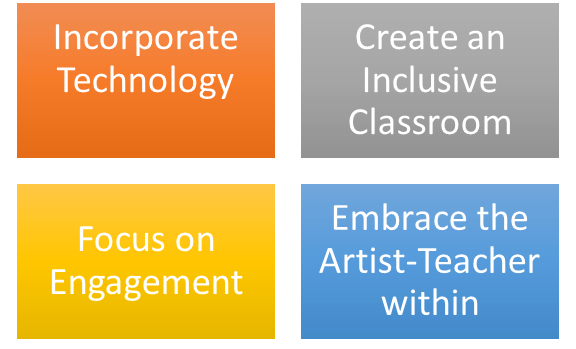
Despite not planning the workshop with these in mind (both the original and altered version), they naturally engaged with these methods. Below is a table that outlines this.
| Method | How |
| Incorporate Technology | The original plan embraced the use of various forms of technology including the tenori-ons, audio recording equipment and electronic instruments. In the altered workshop that is now my realisation, the technology was limited however there was an intention to use it. |
| Create an Inclusive Classroom | The University of Southern California (2019) states that, “A genuinely inclusive classroom is one that is respectful of present diversity, adapts to the needs of all learners, and provides opportunities for collaboration between students.” Due to the nature of the workshop, it was already inclusive of people from different backgrounds with all participants having the same opportunities to be involved within the activities. Furthermore, all activities were adaptable to suit all of the participants’ needs, plus the live sound tracking activity promoted collaboration between the participants. |
| Focus on Engagement | By creating an inclusive workshop space, this naturally created an engaged space as no one was excluded. The University of Southern California (2019) believes there are four ways to engage music students; Teach Improvisational skills- Live sound tracking was an improvisational activity. Learn What Your Students Are Listening Too- We have open opportunities for the participants to discuss their interests in every session. Embrace Individual Interests- Freedom of expression in the improvisational live sound tracking section. Incorporate Technology- Naturally we wanted to do this but were unable to do this to our full potential. |
| Embrace the Artist-Teacher Within | A way to embrace this would have been to use my experiences to inspire the students and shape how I work. This would have been nice to have conducted on March 27th if we had the chance. I could have used problem solving techniques learnt throughout this collaboration process to help the participants solve problems within the workshop. |
Overall, I feel it is important to consider all contextual links in order to engage fully with the task and to develop an informed and reflective critical evaluation.
Reference List
Bamt.org. (2019). British Association for Music Therapy. [online] Available at: https://www.bamt.org/music-therapy/what-is-music-therapy.html.
Higgins, L. (2012). Community Music: In Theory and in Practice. New York: Oxford University Press Inc.
M3 Music Therapy, LLC (2020). What A Music Therapy Session Looks Like. YouTube. Available at: https://www.youtube.com/watch?v=ciubgEkE1i4 [Accessed 18 Mar. 2020].
Plymouth Music Zone (2015). PMZ SESSIONS: Stroke Association Singing Group. YouTube. Available at: https://www.youtube.com/watch?v=pXsOe8P4F7Q [Accessed 18 Mar. 2020].
The University of Southern California (2019). Four Effective Music Teaching Strategies for Today’s Diverse Classrooms. [online] music.usc.edu. Available at: https://music.usc.edu/four-effective-music-teaching-strategies-for-todays-diverse-classrooms/ [Accessed 25 Mar. 2020].
 Emily Pembridge MUS634