18: Further Reflection on March 9th and Sounding Off.

As promised, this final blog will be a reflection on how I feel the realisation of my project went, the workshop on March 9th. It will also include some feedback that I received from Rob. This will be the final blog. I will then write my critical evaluation. Therefore, this blog will not be too detailed and will not discuss the project as whole but only the workshop on March 9th. I will track through each activity individually. This blog will also summarise if I achieved my aims and if I could take this further.


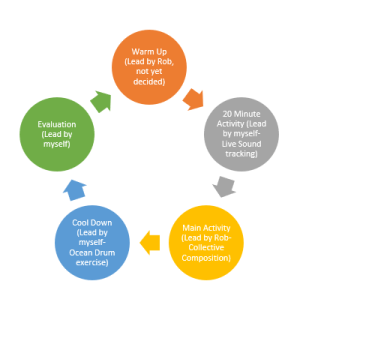
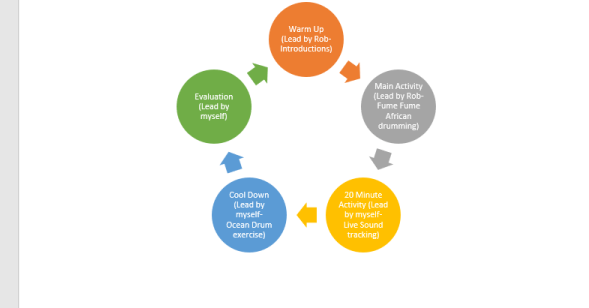
The warm up, lead by Rob, consisted of introducing ourselves to the group. We normally do this at the beginning of Baton Beats in order to welcome any new members and break the ice. This is a fun warm up however upon reflection, I feel that conducting a musical warm up would have been more suited to the workshop.


The main activity was Fume Fume African drumming lead by Rob. As mentioned previously, the Baton Beats group had been working on this for about 3 weeks at the time of the session and so it felt natural to use this as the activity. This was a very successful part of the workshop as all participants engaged well. Furthermore, we used the time that we had wisely and this all developed into a fun and well executed activity.


The 20 minute activity, cool down and evaluation have all been discussed in blog #12 however I will summarise the reflection here.


The 20 minute activity, live sound tracking, was lead by myself. Overall, I feel that this went well and the participants had a lot of fun however some areas could have been refined. These include the layout of the room to include the musicians more, the inclusiveness of the actions for all participants and the way in which participants were chosen to partake. For more detail on this, please refer to blog #12.


The cool down was one of the strongest activities within the workshop, as previously stated, there is nothing I would alter about this upon reflection.


Finally, the evaluation was also a success. I received very helpful feedback from the participants and it is shame I do not have the chance to use this to improve the workshop. Once again, these is nothing I would change about the evaluation.


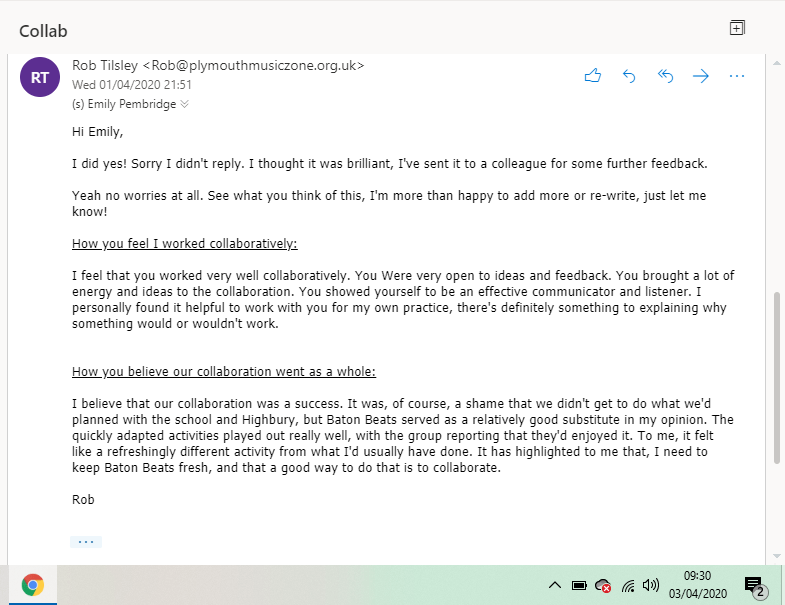
I asked Rob to provide me with some feedback on how he believed I worked collaboratively, and how the collaboration went as a whole. Please see this below.
Rob’s Feedback.

As you can see, Rob’s feedback is wonderful. He believed that I worked very well within the collaboration and that our project worked well as a whole. It is good to see that Rob has become more open to collaborating with others following our collaboration. Rob has also raised a philosophical argument that will be discussed in the critical evaluation. This is that it is good to discuss things that may or may not work.


All in all, I am very pleased with how this collaborative project went despite the disappointment and stresses of the pandemic altering my plans. I feel that the workshop on March 9th went better than expected due to the sudden alteration of the original plan. I believe myself and Rob worked extremely well as a collaborative team and accessed all seven keys of collaboration. Although disappointed that I did not get to conduct my original workshop, I am pleased with how the altered version went and am happy that the closure of PMZ and cancellation of the original workshop was conducted through the best interests of the vulnerable people who attend. I feel that this whole collaborative experience has enhanced my collaborative working practice in every way, through my ability to communicate, form collaborative relationships, finding connections and my whole outlook on collaboration as a practice. This has been proven since Rob has since asked me to collaborate with him on writing a blog about my experience at PMZ for their website! I believe this proves that I have shown myself to be an effective collaborator. I have achieved all of my project aims (despite them being slightly altered) and am sure if the pandemic hadn’t occurred, then the project would have been completed exactly as hoped. As previously stated, due to the sensitivity surrounding safeguarding, the link to the audio recording of my realisation will only be available to the assessor. To conclude, I hope this blog has evidenced how I engaged with various contextual areas throughout this collaborative project meanwhile presenting the collaborative journey.

17: Evaluation in Context 3.

As I mentioned in blogs #6 and #8, the final two steps in the evaluation methodology are to be considered following the evaluation. This blog will set about doing this. Obviously, the outcomes are different as expected and this makes this more difficult than originally planned.


StepPlan
Set standards and collect evidence.I set the standards as part of step two in order to make the process easier. These standards included how I would collect the evidence. My original plan was to ask the Creative School pupils a series of questions. The room would be divided into three sections for Very/Yes, Kind of and Not at all/No. The students would move into the corresponding areas that reflect their answers to the question. No written answers would be required. Information would have been taken by looking at the general consensus and making a note. Instead, due to the change of plan, I asked the Baton Beats group to raise their hands in order to answer the questions. This was documented through the audio recording.
 Report and make decisions.I reported these findings within blog #9 and explained what I would change about the workshop. However, I am unable to implement these decisions due to the 27th being cancelled.
Evaluation table 2.

I feel that by engaging with evaluation methodology throughout this project, it allowed me to conduct my evaluation in a professional and coherent manner. The evaluation and my engagement with the methodology was affected due to the virus however I am still happy with how I approached it.

16: Music Therapy, Community Music and Inclusive Teaching Methodologies in Context.

Another contextual area that relates to the collaboration is Music Therapy, Community Music and Teaching. I wanted to research these during the development of my project as it is important to understand how they relate to my collaboration and if there are any methods I could have carried over. Despite the realisation already taking place, I still wish to place my collaborative project within these areas to see how it fits and gain ideas of how I could use this to influence future projects.


According to the British Association of Music Therapy (Bamt.org, 2019), “Music therapy is an established psychological clinical intervention, which is delivered by HCPC registered music therapists to help people whose lives have been affected by injury, illness or disability through supporting their psychological, emotional, cognitive, physical, communicative and social needs”. Please see a video below of music therapy in practice.

Music Therapy in Practice (M3 Music Therapy, LLC, 2020).

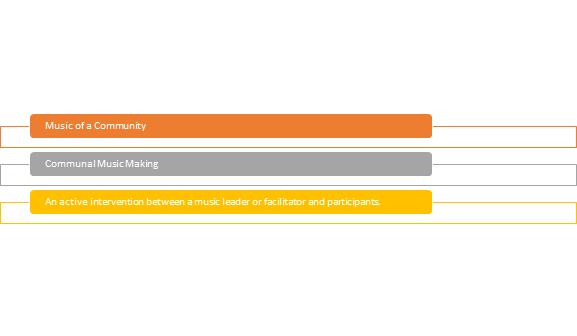
In comparison, Higgins (2012, p.3)states that community music can be three things;

Community Music.

Please see the video below of community music in action at PMZ.

PMZ Community Music (2015).

My project links to this contextual area as it would be classed as Community Music. It brought the community together within the Baton Beats session to create music, therefore inducing communal music making. It embraced music from the African Culture that showcased music of a community and was an active intervention between a music leader and the participants. All participants who come to PMZ are in some way vulnerable, whether that be due to disabilities, learning difficulties, old age or loneliness. Therefore, the music created within the workshop can be seen to be therapeutic. At the end of the workshop, I asked if the group felt that their mood was boosted by the session in which the majority agreed. So despite the workshop not being formal music therapy, the community music created was certainly therapeutic.


As a soon to be trainee music therapist, this workshop gave me valuable experience in working with vulnerable people in a musical environment. It gave me insight into how people react to things differently and that I should be mindful of each person’s individual needs. Furthermore, from seeing how the music impacted the participants in a positive way, this also made me feel positive. This has proven to me that the career path I wish to follow is certainly for me.


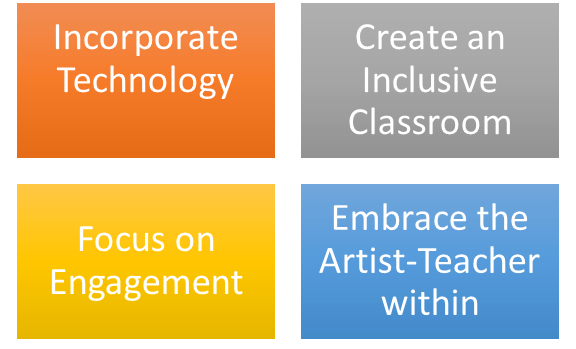
Another contextual practice that links to my collaboration is inclusive teaching methodologies. Despite the workshop I conducted not being a teaching workshop, the principles can be transferred. The University of Southern California (2019) have a page on their website dedicated to this topic. They believe that there are four contemporary music teaching strategies that can be employed to create an inclusive and engaging classroom/work-space. These are as follows;

Methods of Inclusive Teaching.

Despite not planning the workshop with these in mind (both the original and altered version), they naturally engaged with these methods. Below is a table that outlines this.

MethodHow
Incorporate TechnologyThe original plan embraced the use of various forms of technology including the tenori-ons, audio recording equipment and electronic instruments. In the altered workshop that is now my realisation, the technology was limited however there was an intention to use it.
Create an Inclusive ClassroomThe University of Southern California (2019) states that, “A genuinely inclusive classroom is one that is respectful of present diversity, adapts to the needs of all learners, and provides opportunities for collaboration between students.”  Due to the nature of the workshop, it was already inclusive of people from different backgrounds with all participants having the same opportunities to be involved within the activities.  Furthermore, all activities were adaptable to suit all of the participants’ needs, plus the live sound tracking activity promoted collaboration between the participants.  
Focus on EngagementBy creating an inclusive workshop space, this naturally created an engaged space as no one was excluded. The University of Southern California (2019) believes there are four ways to engage music students;
Teach Improvisational skills- Live sound tracking was an improvisational activity.
Learn What Your Students Are Listening Too- We have open opportunities for the participants to discuss their interests in every session.
Embrace Individual Interests- Freedom of expression in the improvisational live sound tracking section.
Incorporate Technology- Naturally we wanted to do this but were unable to do this to our full potential.  
Embrace the Artist-Teacher WithinA way to embrace this would have been to use my experiences to inspire the students and shape how I work. This would have been nice to have conducted on March 27th if we had the chance. I could have used problem solving techniques learnt throughout this collaboration process to help the participants solve problems within the workshop.
How I engaged with each method.

Overall, I feel it is important to consider all contextual links in order to engage fully with the task and to develop an informed and reflective critical evaluation.

Reference List

Bamt.org. (2019). British Association for Music Therapy. [online] Available at: https://www.bamt.org/music-therapy/what-is-music-therapy.html.

Higgins, L. (2012). Community Music: In Theory and in Practice. New York: Oxford University Press Inc.

M3 Music Therapy, LLC (2020). What A Music Therapy Session Looks LikeYouTube. Available at: https://www.youtube.com/watch?v=ciubgEkE1i4 [Accessed 18 Mar. 2020].

Plymouth Music Zone (2015). PMZ SESSIONS: Stroke Association Singing GroupYouTube. Available at: https://www.youtube.com/watch?v=pXsOe8P4F7Q [Accessed 18 Mar. 2020].

The University of Southern California (2019). Four Effective Music Teaching Strategies for Today’s Diverse Classrooms. [online] music.usc.edu. Available at: https://music.usc.edu/four-effective-music-teaching-strategies-for-todays-diverse-classrooms/ [Accessed 25 Mar. 2020].

15: Presentation.

Due to the University stopping face-to-face lectures etc, the presentation on 20/03/2020 will no longer be going ahead. To view the presentation and the script, please follow these links.

Presentation: https://liveplymouthac-my.sharepoint.com/:p:/g/personal/emily_pembridge_students_plymouth_ac_uk/EXZRp6xP3kJFvbSvn4ALDggBttTTOtAybilUNOeDo8UyBA?e=tF6KkQ

Script: https://liveplymouthac-my.sharepoint.com/:w:/g/personal/emily_pembridge_students_plymouth_ac_uk/ESkfB2bHzgxMo8sZsnGe4FUBtBprR5-Fuq7SWfuqJ3utNA?e=RalbS6

13: Next steps.

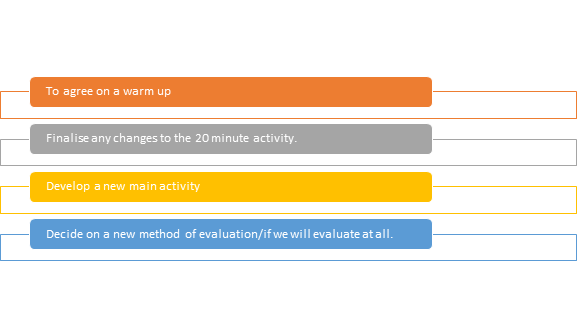
The next steps for myself and Rob are to continue planning the session as if it will go ahead on March 27th. We have since received confirmation that school will not be attending. As of now, the Highbury Trust are still coming. Rob has a workshop with them today and will be doing the main activity with them in case the 27th does not go ahead. Therefore our next steps in planning are;

What is left to plan.

Since Rob has chosen to run the main activity today, this leaves us with room to plan a new one which is exciting. Since the Creative School have dropped out of the workshops, I will potentially no longer evaluate the session on the 27th as the Highbury Trust members have quite complex needs and it may be difficult to gain consent from them.


Rob has informed me that the likelihood of the final session taking place following this is extremely slim. He said it is likely that PMZ will close their doors soon in order to prevent the spreading of the virus to vulnerable people. He will keep me updated on this situation.

12: Reflecting on March 9th.

As the session on March 9th may be the end realisation of this project, I feel a short reflection and evaluation is necessary. If the workshop on March 27th is cancelled, then a longer reflection and evaluation will be uploaded. I will be focusing on the original aspects of the plan which are as follows;

Aspects of original plan used on March 9th.

I will evaluate the workshop as a whole in a future blog if the workshop on March 27th is cancelled.


As is evident from the audio recording, the 20 minute activity was popular among the group. The majority of the participants found the comical elements funny and enjoyed joining in with the activity. However, there were some elements that I feel I could change that would improve the activity in the future. Firstly, the participants didn’t quite understand the concept that each others’ actions were influencing each other, for example, the actor influencing the musicians choices. I feel this is partly from my lack of explanation but also due to the way in which the room was laid out. The chairs were arranged in a circle and the instruments were around the outside of the circle. This meant that often the actor was in the middle of the circle and the musician was removed from the situation. If I am able to do the workshop on March 27th, I will make this element clear through verbal explanation and will also move the chairs into rows so the musician and actor feel as though they are on stage together. I also received feedback from one of the volunteers following the session. He said that when it comes to doing this activity on March 27th, the Creative School pupils may not be as willing to do the exercises. In order to overcome this, I will ask the teachers to choose who they wish to do the activity. Rob and I feel this is a good idea as the teachers will know who is confident and who would enjoy it. They can also tell who may benefit most from the experience. A final aspect I would change is ensuring each activity is suitable for all of the participants as some require walking which some members of the Highbury Trust may be unable to do due to limited mobility.


The cool down was also successful and I feel that nothing about this activity needs to be changed/improved.


During the evaluation, I received amazing feedback from the group saying that the session was a lot of fun and that I did a really good job of delivering it! One participant said that they found the activities challenging however she too said that she enjoyed the experience. I will later write a blog on how the evaluation conducted fits into the evaluation methodology I researched.


Overall, I would be happy to use this workshop as my realisation however it would be lovely to run the workshop on March 27th and improve the areas I feel could be better. Furthermore, I feel that the Highbury Trust and Creative School participants would really enjoy the session!

11: Coronavirus Disaster.

On 09/03/2020 I had my third meeting with Rob in which we were going to discuss everything we have decided so far and finalise any other collaborations that we needed to make. I was also going to trial the main activity that evening within the Baton Beats session. However, the whole project became compromised due to the Coronavirus outbreak. Rob said that it was highly likely that the workshop would not take place due to the government’s potential implementation of social distancing, particularly for vulnerable people. Therefore we had a huge problem to overcome. I had two options, the first to ignore Rob’s warning, continue planning the workshop for the 27th March and A) It either go ahead or B) The workshop is cancelled and I have no realisation for my project. My second option that Rob suggested was that we ran the workshop that evening, during the Baton Beats session. The workshop we had planned for March 27th was tailored for the participants from the Highbury Trust and the Creative School. This was the plan for the 27th;

The original plan.

The workshop was going to be lead by myself and Rob within different sections however all of the ideas within the workshop were collaboratively developed as evidenced in my previous blogs. By doing the workshop that evening, it meant that we would not be able to use the main activity as this was specifically developed to meet the aims of the Highbury Trust and the Creative School. This also meant that I would have to tailor my evaluation around the change. Myself and Rob decided that if we ran an altered version of the workshop that evening then I would have a realisation for my project, even if it is not the exact original that was planned. Furthermore, if the workshop goes ahead on the 27th March, then it would have been a good trial run. Upon deciding this, we then had an hour to problem solve and collaborate on an altered version of our original plan.


My first concern was audio recording consent, consent for the evaluation, safeguarding and risk assessing. Luckily, because Baton Beats is a weekly workshop at PMZ, all participants sign consent forms when they join the group. Furthermore, PMZ have safeguarding and risk assessments already in place which meant that I no longer had to worry about these aspects and we could begin arranging the session.


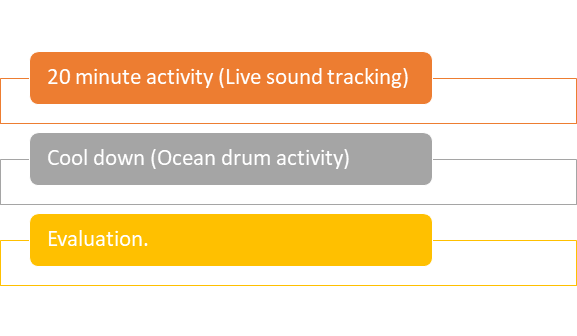
We decided that as Baton Beats are already working towards their own goals, we would incorporate this into the session. We decided that the structure would be as follows;

The altered plan.

The warm up was the usual warm up we tend to use during the Baton Beats session. The main activity was Fume Fume which is an African Drumming song that the group have been learning for roughly three weeks. As I work at PMZ, I collaborate with Rob on this exercise every week to deliver it to the group so despite us not having planned this from the beginning, it is still a long term collaborative project within its own right. Within this exercise, we decided to teach the group the lead drumming parts. The 20 minute activity was exactly as planned for March 27th, as was the cool down. The evaluation was also similar however I only asked the three questions that were generic rather than the ones tailored to the original planned session. We audio recorded the 20 minute activity, the cool down and the evaluation as these were within the original plan. In order to remain in line with GDPR, the file is only available to myself and the assessor who I will give the link to once the assignment is finished. The audio recording will then be destroyed.


We then set about setting up the room for the session using the kit lists that were planned for the 20 minute activity and the cool down. We then had to also arrange the equipment for the altered sections of the workshop.


Overall, despite conducting the workshop two weeks early, altering it to fit a new group and working under pressure, myself and Rob’s collaboration and problem solving really paid off. As you can hear in the recording, the group had fun throughout the 20 minute exercise and the cool down and I received really helpful feedback from the group members during the evaluation. Furthermore, the session as a whole including the altered parts fitted in well with the rest of the workshop and felt natural.


This event had an effect on how we engaged with every single collaborative key (Spencer, 2017). In 45 minutes we had to depend on each other and trust each other that we would be able to support one another within the new structure. We had to ensure we were still working towards the shared vision and having fun meanwhile problem solving. We had to be coherent and kind when using candour in order to remain feeling empowered. This event taught me a lot of key collaborative skills including patience, problem solving, trust and inspiration and I feel that the continual growth that my collaborative self had been on throughout this project paid had off during this moment.


Myself and Rob are now going to continue planning the session for March 27th until we receive confirmation that it will not be going ahead. We will use the feedback from March 9th to improve the workshop itself. If the session is cancelled on March 27th then the audio recording of March 9th will be the realisation of this project and a blog will be uploaded explaining the situation. As is understandable, it is a stressful situation to be in however I feel we overcame the issue calmly, professionally and worked together to form the best outcome that we could.


Reference List

Spencer, J. (2017). The 7 Keys to Creative CollaborationYouTube. Available at: https://www.youtube.com/watch?v=2DmFFS0dqQc [Accessed 8 Feb. 2020].

10: Safeguarding.

Since the workshop means that I will be working with children and vulnerable adults, I feel it is necessary to familiarise myself with the basics of safeguarding for both adults and children. I am already safeguarding trained as I undertook a training day last year within my job back home. My role is a play worker for children with serious neuro-developmental difficulties and disabilities. As this training took place last year, I have given myself a short refresher. I will summarise my understanding within this post.


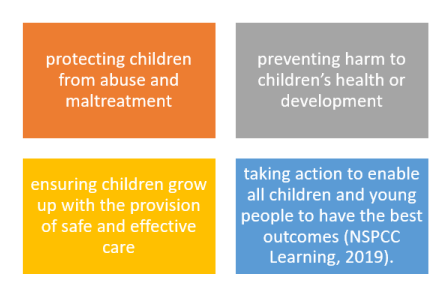
As written on the NSPCC website, child safeguarding is any action that is taken that aims to promote the protection, welfare and safety of children. Safeguarding means;

Child safeguarding.

According to Keeping Children Safe, to safeguard you must be aware and vigilant of the signs of sexual abuse, physical abuse, child sexual exploitation, commercial exploitation and of any potential risks that the environment has that the children might come into contact with. I must be aware who to report to if I have any concerns, in my case, this would be Rob as he is the workshop lead. Furthermore, I must also be mindful of the use of media hence why I wish to make the school aware that I want to audio record the session. If the school object then I will not follow through with the audio recording.

Luckily, as I am collaborating with PMZ, there will already be an agreed safeguarding policy in place. Furthermore, the Creative School students will have teachers who are supporting them throughout the workshop. I will personally implement safeguarding by embracing and accepting any rules I have been given prior to the session, such as only having one person in the kitchen/toilets at one time and no members of staff being alone with the children.


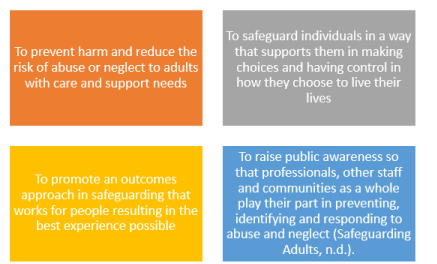
To familiarise myself with adult safeguarding, I have read the online document presented by the NHS. Safeguarding means protecting the person’s right to live without harm and in safety. In 2014, the government implemented the care act in which each local authority must follow. The aims of safeguarding in adults is to;

Adult Safeguarding.

Like child safeguarding, I must be aware of all forms of abuse, modern slavery, financial or material abuse, neglect and self neglect. Once again I must also ensure that I make the trust aware of any audio recording that I wish to carry out. As previously mentioned, the Highbury Trust support workers will be present so there will already be safeguarding procedures in place, similar to those of the Creative School.


Ultimately, I must be mindful of any potential risks, harm or suspicions I may have surrounding the safeguarding and well being of the children and the adults who I will be working with. I must know who to report to and the signs to look out for if something is wrong. I must look out for myself and others by following any rules and boundaries that PMZ, the Creative School or the Highbury Trust inform me of.

Reference List

NSPCC Learning. (2019). Safeguarding children and child protection. [online] Available at: https://learning.nspcc.org.uk/safeguarding-child-protection/. [Accessed 08 Mar. 2020]

Safeguarding Adults. (n.d.). [online] Available at: https://www.england.nhs.uk/wp-content/uploads/2017/02/adult-pocket-guide.pdf. [Accessed 08 Mar. 2020]

9: Main Activity.

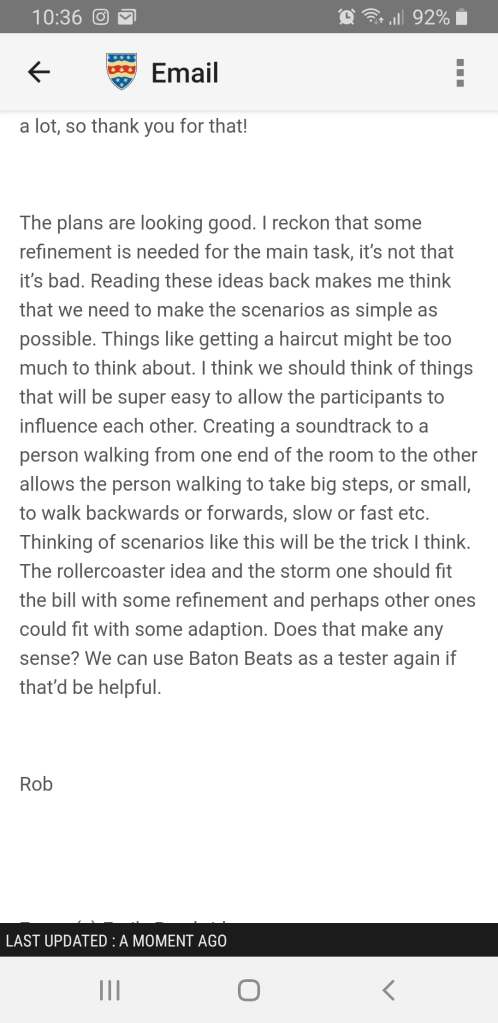
Rob emailed with some feedback regarding my plan for the main activity. As you can see from the email below, he thought it was good idea but believed some of the actions are too complex for the participants to carry out.

Email from Rob with feedback regarding the main activity.

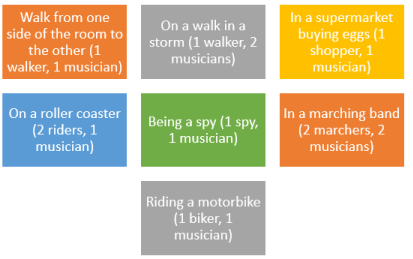
Therefore, I had to have a rethink and have edited the plan slightly. The actions I have now chosen are as follows;

New action ideas.

These actions are all simple to improvise and can be completed within the time frame. I have also decided to remove the emotion aspect of the activity. The original plan was to ask the participants to act the action with a certain emotion however I feel that this over complicates the exercise. This new plan will be tested on 9/03/2020 with the Baton Beats group that I attend. This will help me to evaluate whether it works or not. If you wish to view the updated plan, please follow this link: https://liveplymouthac-my.sharepoint.com/:w:/g/personal/emily_pembridge_students_plymouth_ac_uk/EWVyRZxK0FdLl-zfMvO92oEBkelvTHBas51sT7PVHjkyTA?e=in67XC


In this post, it feel it is necessary to talk about some problems I have faced in engaging with the Seven Keys of Collaboration (Spencer, 2017). Due to Rob still not sending me the samples, the trust and dependability within the collaborative partnership is lacking. This therefore has a knock on effect to the rest of the keys. This then affects my motivation as I am running out of individual tasks to do. Shotter (1984) believes that we live within ‘joint action’. This means when we meet and interact with people, we respond in a mutual way. As we are always influencing each other, we cannot separate ourselves from the collaborative relationship. This explains why my productivity decreased when Rob’s dependability was lacking. To overcome this and avoid a breakdown of the collaboration, I decided to wait until I could discuss this in person with Rob so we could have a meaningful and intentional conversation.


As of yet, I have not received the samples from Rob in order to start developing the idea of the theme for the improvisational composition section of the workshop. On 9/03/2020, prior to Baton Beats, I am having a meeting with Rob and so I wish to find out how long this will take. I also aim to have finalised the main activity following the Baton Beats session.


My personal tutor has approved my updated ethics form so I am now waiting to be given the contact details of the school and trust to make them aware of my plans.


Reference List

Shotter, J. (1984). Social accountability and selfhood. Oxford: Blackwell.

Spencer, J. (2017). The 7 Keys to Creative CollaborationYouTube. Available at: https://www.youtube.com/watch?v=2DmFFS0dqQc [Accessed 8 Feb. 2020].

Design a site like this with WordPress.com
Get started